Sizing
What Size Dumpster Do I Need? A Lakewood, CO Guide
The 20 yard is the all-purpose pick. How to choose between 10, 15, 20, 30 and 40 yards by volume, weight and driveway space around Lakewood.
Read the guideGuidelines · 8 min read
Most of what comes out of a house or a job site can go in a roll-off. The exceptions are the things Colorado keeps out of its landfills or that need special handling, and each of them has somewhere else to go.
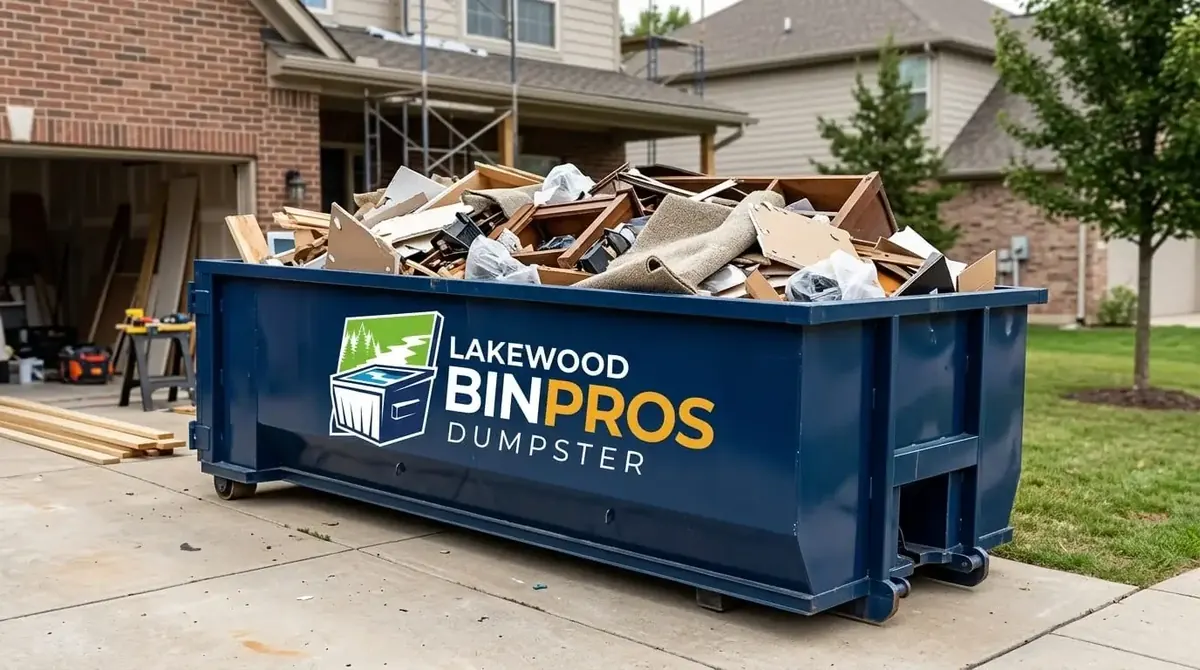
Colorado's list of materials banned from landfills is short and specific, so most building and household debris is fine. We found no Colorado mattress or appliance stewardship law. And Colorado's new packaging program (C.R.S. 25-17-701 and following) funds residential recycling only — it has no effect on roll-off or construction debris service.
CDPHE lists the residential materials "prohibited from disposal in a solid waste site or facility in Colorado": lead-acid batteries; liquid wastes or wastes containing free liquids, unless the facility is specifically approved for them; used oil; waste tires, unless no other option exists; and waste electronic devices and computers. Here is the law behind each, and where the item goes instead:
| Item | The rule | What to do instead |
|---|---|---|
| TVs, computers, monitors, laptops, tablets, e-readers, printers, fax machines, DVD players and VCRs | C.R.S. 25-17-303: no electronic device or component in a Colorado landfill since July 1, 2013; covered devices listed in 25-17-302(3)(a) | An electronics recycler, or Rooney Road for residents of its member cities; our junk removal handles electronics and sends them to recycling whenever possible |
| Car and truck batteries (lead-acid) | C.R.S. 30-20-1002(1): land disposal of residential lead-acid batteries banned since July 1, 2007 | A battery retailer or wholesaler, a secondary lead smelter, or a collection or recycling facility (30-20-1002(4)) |
| Used motor oil | C.R.S. 30-20-1005(1); every quart improperly disposed of is a separate violation | A collection or recycling facility — Rooney Road takes motor oil from residents |
| Waste tires | C.R.S. 30-20-1414: only to a tire collector, processor, monofill or collection facility; each tire is a separate violation, and hauling ten or more in one load takes CDPHE registration (30-20-1408) | A tire collector or processor — never in the box |
| Liquids, including liquid paint and chemicals | CDPHE: no free liquids unless the facility is approved for them | Household hazardous waste collection (below) |
| Fridges, freezers and A/C units | 40 CFR 82.155: the final processor must recover the refrigerant or verify it was recovered | Our junk removal takes appliances with proper preparation |
| Household batteries (portable and medium-format) | C.R.S. 25-17-1014(2), from January 1, 2030 only (SB25-163) | Already on our no list — keep them out now |
Three common myths. Colorado has no landfill ban on white goods that we found — the fridge rule is the federal refrigerant rule. The ban on putting household batteries in landfills does not start until January 1, 2030; today only lead-acid batteries are banned by statute, though batteries are on our no list anyway. And the electronics ban does not cover everything with a plug: telephones, devices built into washers, dryers, fridges, ovens and microwaves, and cell-type devices with screens of four inches or less are outside the definition (25-17-302(3)(b)).
Our own no list: paint, solvents and oils, fuel and hazardous liquids, tires, batteries, hazardous chemicals, gas cylinders, propane tanks and other pressurized containers, medical waste, asbestos and appliances containing refrigerants. For a yard waste box, also leave out treated and pressure-treated lumber, plastic containers, fertilizers, chemicals and household trash. If you are unsure about something, call (720) 370-8548 before you load it — it is far cheaper than finding out at the gate.
Colorado also makes haulers tell their customers a few things, so consider this our notice: land disposal of lead-acid batteries is prohibited, and they can go back to a retailer or wholesaler, a secondary lead smelter, or a collection or recycling facility (C.R.S. 30-20-1002(4)); land disposal of used oil is prohibited (30-20-1005(6)); and waste electronic devices are prohibited from disposal, which haulers must post (CDPHE).
| Item | What to do with it |
|---|---|
| Paint, solvents, pesticides and other household chemicals | Rooney Road Recycling Center, 151 S. Rooney Rd, Golden — by appointment, Wednesdays and Saturdays 8 a.m. to 2 p.m., for residents of Arvada, Edgewater, Golden, Lakeside, Lakewood, Morrison, Mountain View, Wheat Ridge and unincorporated Jefferson County. Denver residents book the City's at-your-door collection, one appointment a year with a co-payment. |
| Used oil | Banned from land disposal in Colorado. Rooney Road takes motor oil from residents. Never in the box. |
| Car and truck batteries | Back to a retailer or wholesaler, or to a collection or recycling facility. Never in the box. |
| Propane tanks and gas cylinders | On our no list. Keep them out of the box. |
| Tires | Waste tires go only to a tire collector, processor or collection facility. Keep them out of the box. |
| Fridges, freezers and A/C units | The refrigerant must be recovered first (40 CFR 82.155). Our junk removal service takes appliances with proper preparation. |
| TVs, computers, monitors and printers | Banned from Colorado landfills (C.R.S. 25-17-303). Rooney Road takes e-waste from residents, and our junk removal service handles electronics and directs them to recycling whenever possible. |
| Asbestos-containing materials | Never in our boxes. Inspection, notice and disposal rules are below. |
| Medical waste | On our no list. Keep it out of the box. |
| Branches only | Jefferson County's slash yards take tree limbs and prunings — not lumber, stumps or detached leaves — and Lakewood households get one free voucher visit in season. |
Business hazardous waste is different: Rooney Road does not subsidize it and books it by phone only. Outside the Rooney Road area, check your own city — Englewood, Littleton and Sheridan run their own household hazardous waste programs.
Federal law puts the duty on "The final processor—i.e., persons who take the final step in the disposal process (including but not limited to scrap recyclers and landfill operators)" of a small appliance, who must either recover any remaining refrigerant or verify, with a signed statement or contract naming who recovered it and when, that it has been recovered (40 CFR 82.155). We found no Colorado landfill ban on white goods, and Colorado's electronics law leaves out devices built into washers, dryers, fridges and freezers — so for a fridge, freezer or window unit it is the refrigerant that matters. Denver's Large Item Pickup does not take appliances either. That is why appliances containing refrigerant stay out of our boxes. If you would rather not deal with a fridge or an A/C unit yourself, our junk removal service takes appliances with proper preparation.
Under the state's Regulation 8, CDPHE requires the area to be "inspected for asbestos by a Colorado-certified asbestos inspector" before demolition, and "A ten working-day notification period is required before the demolition can commence." The demolition notification form is filed "even if no asbestos was found", homes included, with a fee of $50 plus $5 per 1,000 square feet. For homes, abatement rules kick in at 50 linear feet, 32 square feet or one 55-gallon drum of asbestos-containing material. CDPHE's asbestos unit is at cdphe.asbestos@state.co.us, 720-507-5136.
Asbestos waste "must be disposed of at an approved asbestos waste disposal site, regardless of the quantity", and concrete or wood bonded or contaminated with asbestos-containing material cannot be recycled. Denver's household hazardous waste collection does not take asbestos, including linoleum tiles from older homes. Never put asbestos in a roll-off.
It pays to sort the way the recycling rules do. Lakewood's construction and demolition rules require asphalt, concrete, cardboard, untreated wood, metal and reusable architectural salvage to be recycled on covered projects, with weight tickets as proof (§14.02.040(J)), and Denver's ordinance counts concrete, asphalt, masonry, untreated wood, metal, corrugated cardboard and reused items. A clean load of concrete and asphalt can go to recycling; the same material mixed into a remodel load usually cannot. Remodel and tear-out debris is a different load again, and household junk from a cleanout is a third.
So keep brush in its own load where you can, keep heavy concrete and brick apart from everything else, and do not mix a household cleanout into a remodel box without telling us. Whenever possible we send metal, concrete, asphalt, cardboard and yard debris to recycling, and if your permit needs weight tickets, tell us when you book. If you are not sure where something belongs, call before you load it.
Talk to a real person
Call (720) 370-8548 with the address and what is going in. A flat price and a delivery window before you hang up.
Open 24 hours, 7 days
From this guide
Yes. Roofing materials and shingles are on our accepted list. They are heavy, so our 10 and 20 yard dumpsters are the usual picks for roofing — tell us the roof size and we can estimate the weight.
No. Colorado has banned electronic devices from landfills since July 1, 2013 (C.R.S. 25-17-303), including TVs, computers, monitors, laptops, tablets and printers. Telephones are not covered. Our junk removal service handles electronics and directs them to recycling whenever possible.
Neither goes in. Colorado bans land disposal of car batteries and sends waste tires only to tire collectors and processors. The wider ban on household batteries in landfills starts January 1, 2030, but batteries are already on our no list.
No. Federal rules require the refrigerant to be recovered before a fridge, freezer or window unit is disposed of (40 CFR 82.155). Our junk removal service takes appliances with proper preparation.
Keep reading
The rest of the series, same approach — official sources, no filler.
Sizing
The 20 yard is the all-purpose pick. How to choose between 10, 15, 20, 30 and 40 yards by volume, weight and driveway space around Lakewood.
Read the guidePermits
Driveway first: a Lakewood street needs a no-charge Public Way permit, state highways have no path. Plus Denver, Jeffco and nearby city rules.
Read the guideCost
Lakewood dumpster rentals typically run $350 to $750. What is inside that number, what moves it, and the permit and drop-off costs worth knowing.
Read the guide